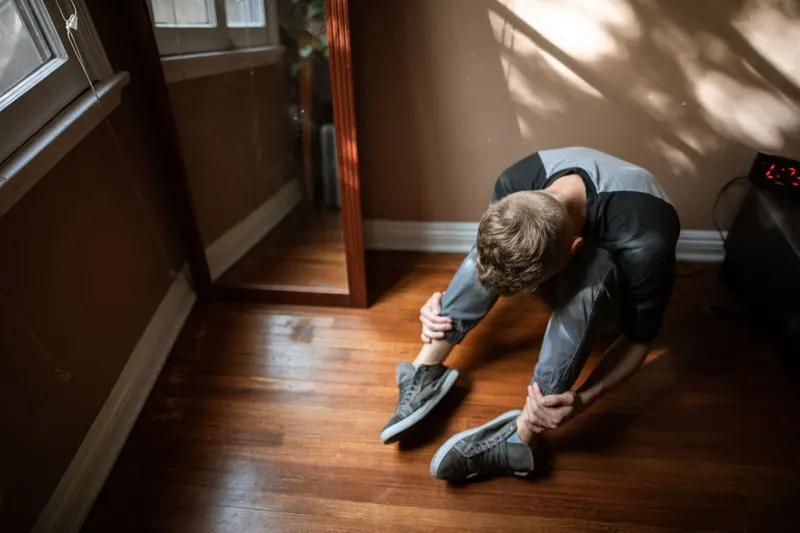
Mental Well-Being: Young Adults Feel Worse Than Elders
28.6% of young people ages 18 to 25 showed moderate or severe symptoms of anxiety or depression, according to Columbia.


What if older people aren't happier, just quieter? A Columbia University study across 92 countries, as reported by Infobae, found the lowest mental well-being among people ages 18 to 25.
Picture the Sunday table. Someone who is 70 says everything used to be harder, and laughs. Someone who is 20 nods, looks at their plate and says nothing. The survey, with 53,799 participants and published in Social Indicators Research, puts numbers to that scene. And no, it doesn't say your generation is broken.
The Data Point That Breaks the Curve
For years, people repeated that well-being forms a U: high in youth, low in middle adulthood and high again in old age. Data collected between June and August 2025, with questionnaires in 50 languages, show something different.
«Your worth isn't measured against anyone else's life.»
The team led by Kai Ruggeri at Columbia University found that young adults had the lowest scores of all age groups.
Among ages 18 to 25, 14.7% showed no signs of anxiety or depression, and 28.6% fell in the moderate or severe range. The hit showed up in emotional stability, resilience and vitality: the ability to bounce back and the energy to get up each day.
The authors urge caution. The survey was online, the samples don't perfectly represent each country, and the results can't be used to build rankings. They also don't claim that every young person has a disorder. They describe a trend.
What Home and Work Hold Up
A Global Mind Project report, presented in early 2026 with responses from more than a million people in 85 countries, reached a similar place. Its chief scientist, Tara Thiagarajan, warned that nearly half of young adults face clinically significant conditions. That work points to weakened family ties, less spirituality, cellphones at an early age and ultra-processed foods. The two studies can't be compared directly, but they agree that the age gap deserves attention.
Psychologist Sonia Almada wrote a line in an Infobae column that works for the Sunday table: "Before asking them to find their place in the world, we have to make room for them."
The Columbia study also found associations, not causes. People who work, earn more or have more education tend to report better well-being. Living with others beats living alone, and larger households score higher than single-person ones. Hybrid or in-person work beat fully remote work. None of that fully explains your situation, and the authors know it.
A Hope That Doesn't Depend on Age
The data say older people report better well-being. That doesn't make their lives easier or yours a spiritual failure. Scripture doesn't promise a stretch of life without cracks; it promises company in the middle of exhaustion: "The Lord is near to the brokenhearted" (Psalm 34:18, ESV). And to those who feel they are not enough, it answers: "My grace is sufficient for you, for my power is made perfect in weakness" (2 Corinthians 12:9, ESV).
Comparing yourself with your grandfather or with the classmate who seems to have it all figured out tells you nothing about God's love. Your worth isn't measured against anyone else's life. It rests on something that doesn't depend on age, mood or the good spirits of a Sunday.
This week, put a name to what you feel and tell someone you trust: a friend, your pastor, an adult who knows how to listen or a mental health professional. If the distress overwhelms you, go to the emergency services in your country or look up the helpline available where you live at findahelpline.com. You don't have to perform to be cared for.
What is harder for you to say out loud: that you're tired or that you need help?