Christians in the Holy Land Keep Shrinking
In Bethlehem, the Christian population went from 84% in 1947 to about 12% in 2016, according to International Christian Concern.

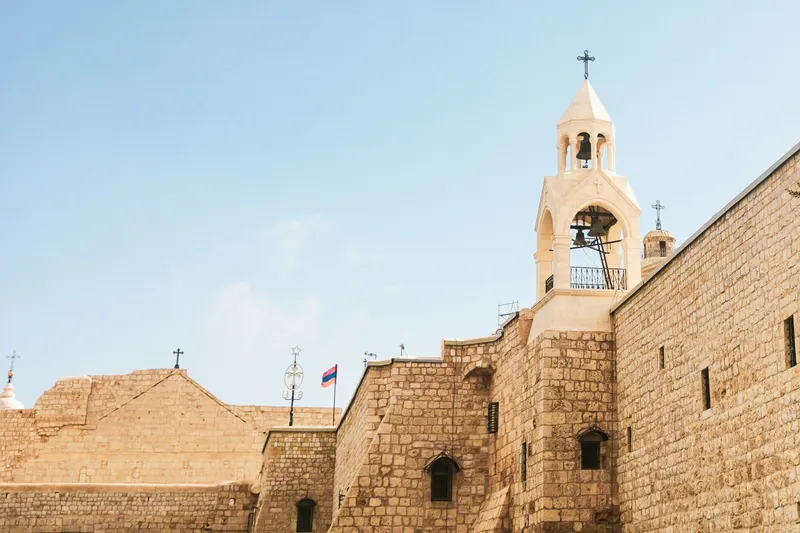
Christians in the Holy Land are shrinking year after year because of emigration, war and movement restrictions, according to the series that International Christian Concern (ICC) publishes about the Christian Middle East. The most visible case is Bethlehem.
Bethlehem: from majority to minority
Every December the bells ring over the stone streets and pilgrims walk toward the Church of the Nativity. Cameras carry those images to Christian homes around the world. Outside the pilgrimage sites the picture changes. The churches are still standing; what's missing is the people who fill them.
ICC reported in 2025 that Christians once made up about 85% of Bethlehem's residents. Today they are a small fraction. According to the organization, in 1947 they represented around 84%; by 2016 the figure had dropped to about 12%, and across the West Bank they are less than 2%.
«The churches are still standing; what's missing is the people who fill them.»
Palestinian Christian communities bring together Greek Orthodox, Roman Catholic, Armenian, Syriac, Lutheran, Anglican and evangelical traditions. Their footprint goes beyond the temples: schools, hospitals, universities, businesses and charitable works. Their families worked for generations as teachers, doctors, merchants, artisans and leaders of their communities.
Permits and controls that weigh heavy
Moving between Gaza, the West Bank, Jerusalem and Israel is heavily regulated. Permits, checkpoints, security restrictions and closures decide whether a Palestinian Christian can attend a religious celebration, visit a relative or reach their church.
In 2019, ICC reported that Christians in Gaza did not know if they would receive permits to travel to Bethlehem at Christmas. Israeli authorities first said they would not grant them and later approved some requests, citing security considerations. For a Christian living thousands of miles away, visiting Bethlehem is easier than for one living just a few miles away.
On top of those procedures come political conflict, economic hardship, insecurity and religious tensions. Then the question stops being how to stay and becomes why stay.
Gaza: a community of a thousand people
Before the war, Gaza was home to about 1,000 Christians, mostly from the Greek Orthodox community, with a smaller Catholic group. After Hamas's attack on October 7, 2023 and the war that followed, the temples became shelters for families.
An explosion hit a building inside the Greek Orthodox Church of Saint Porphyrius compound, where civilians were sheltering, and people died. ICC also documented families taking refuge in the Catholic Holy Family Church. In such a small group, every departure weighs heavy: a community of millions can recover after a war; one of 1,000 people, maybe not.
The pattern repeats across the region. The Islamic State group drove Christians out of the Nineveh Plain in Iraq. War scattered communities in Syria. Economic collapse and political instability pushed Lebanese abroad. The sixth part of the series will tell what happens where Christianity was once dominant and today only remnants remain.
What can you do? Pray for the Christian families of Bethlehem, Gaza and Jerusalem. Get informed with data and not rumors, and if your church has brothers and sisters who came from those places, reach out to them. "Rejoice with those who rejoice, weep with those who weep" (Romans 12:15, ESV).