Christians and the beasts: myth or truth
Roman documents and the believers of the first centuries confirm that the condemnation existed.

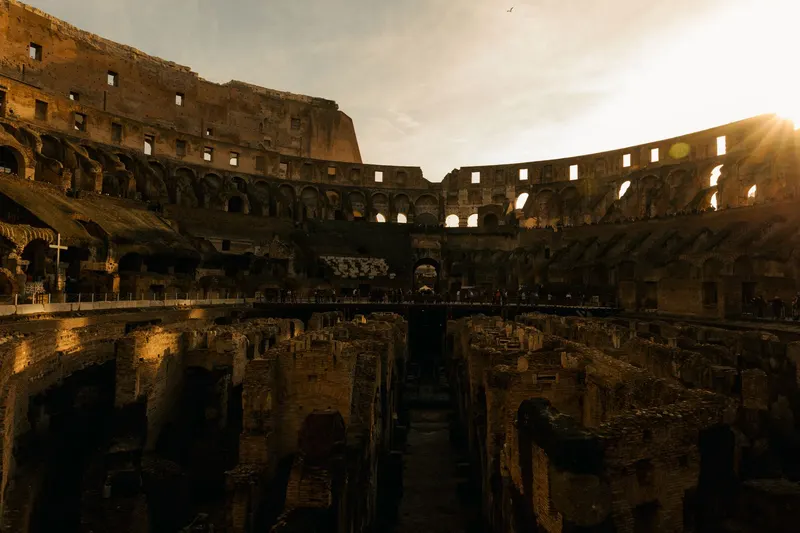
Yes: in the Roman Empire there were Christians thrown to the beasts, condemned to die for their faith. Tacitus, a Roman historian who was not a believer, wrote it down, and other voices from antiquity confirm it.
The verdict is TRUE. The claim circulates in the church and in popular culture, almost always mixed with inaccurately told details. It is worth separating the core fact from the exaggerations that surround it.
What was written down
Tacitus, in his Annals, recounts that after the fire of Rome in AD 64, Nero blamed the Christians to divert suspicion. Some he handed over to the dogs after covering them with wild animal skins; others he executed on crosses or used as torches to light his gardens. Suetonius, in his Life of Nero, also records that Christians were punished. That happened in the circus and in the emperor's gardens. The Colosseum did not yet exist.
Ignatius, bishop of Antioch, wrote in chains on his way to Rome at the beginning of the 2nd century. In his letter to the Romans he asked that no one try to prevent his death and confessed that he longed to be thrown to the beasts. The writing is preserved.
In Carthage, around the year 203, under the emperor Septimius Severus, the proconsul Hilarianus sent to the beasts Perpetua, married and with a baby, who was about twenty-two years old, along with the slave Felicity and other companions. The men of the group faced a leopard, a bear, and a boar; the women were let loose on by a wild cow. They ended up beheaded.
In Lyon and Vienne, in 177, the letter that those churches sent to their brothers in Asia and Phrygia, preserved by Eusebius, recounts that Maturus, Sanctus, Blandina, and Attalus were taken to the amphitheater to be thrown to the beasts. Blandina, who was a slave, was suspended from a wooden post with the beasts around her and then thrown in front of a bull. Along with her died Ponticus, a fifteen-year-old adolescent.
The Colosseum was not the setting
Britannica points out that there is no certainty that the arena of the Colosseum was the place where the first Christians died, although many people take it for granted. Its inauguration took place in AD 80, with Titus as emperor, sixteen years after the fire of Rome.
An article from the University of Queensland reviews the most repeated ideas on the subject and shows that several do not hold up. Throwing someone to the beasts was one form of execution among others used by Rome, such as decapitation and burning at the stake, and it was also applied to prisoners who were not believers.
That it was a common penalty does not erase the motive. Against the followers of Jesus it was used because of their faith, and that is stated both by the believers who suffered it and by the Roman authors who looked at the events from the outside.
How to recognize an inflated version
Similar stories almost always fail at the same point: they change the setting, inflate the numbers, or erase the witnesses. When a martyr story reaches you through social media, check three things. If it names ancient sources and not just a "they say." If it distinguishes the core fact from the debatable detail. And if the names and places can be traced.
Hebrews 11:35-38 already described those who preferred suffering rather than deny Christ, and mentions those who did so "to obtain a better resurrection" (Hebrews 11:35, ESV). Revelation 6:9-11 shows those killed for the word of God crying out under the altar, and Revelation 2:10 summarizes their hope: "Be faithful unto death, and I will give you the crown of life." (Revelation 2:10, ESV)
The accounts of martyrs are not legends invented centuries later: they were written by the believers of the first centuries themselves, and they are confirmed by Roman authors who did not share their faith. You should end up more sure of the Bible and of the Christian testimony, not with doubts. If you are going to share a story like this, also share where it comes from. And when following Jesus costs you something, ask yourself what hope sustains you.
Sources
- Tácito, Anales XV.44 (LacusCurtius, Universidad de Chicago)
- Suetonio, Vida de Nerón 16 (LacusCurtius)
- Ignacio de Antioquía, Carta a los Romanos (Early Christian Writings)
- Pasión de los santos mártires Perpetua y Felicidad (ANF vol. 3, CCEL)
- Eusebio, Historia Eclesiástica V.1 (NPNF, CCEL)
- Universidad de Queensland, «Mythbusting Ancient Rome – throwing Christians to the lions»
- Britannica, «Colosseum»
- Britannica, «Christianity: relations with the Roman government»
- Bible Gateway, Hebreos 11:35-38 (RVR1960)
- Bible Gateway, Apocalipsis 6:9-11 (RVR1960)
- Bible Gateway, Apocalipsis 2:10 (RVR1960)




